
Camisea Natural Gas Project - Amazon Watch
Home  |  Newsroom  |  In the Amazon  |  Capacity building  |  Take action  |  About us
Bolivia  |  Brazil  |  Colombia  |  Ecuador  |  Peru

Home : In the Amazon : Peru : Camisea Natural Gas Project  


Peru

Camisea Natural Gas Project


Indigenous Peoples Pay the Price for Company Profits

Table of Contents

 
  1. Project Overview
  2. Hunt Oil Stands to Gain
  3. Inter-American Development Bank Flouts International Standards
  4. Camisea Pipeline Scars Primary Rainforest
  5. Indigenous Peoples Pay the Price for Company Profits
  6. Camisea Consortia's Deadly History

We have this deep fear for our children and for the heritage that will be left behind. Because our children will have children and our grandchildren will too. But maybe we won't exist anymore.

Marianeli Mantaro Ortega, Shivankoreni Community, June 2003

Camisea children
© 1998 Lilly/Amazon Watch.
Some of Camisea's children.

The Camisea Project continues to jeopardize the health and safety of Machiguenga indigenous communities who live in small communities along the Urubamba and Camisea Rivers. The reduction in fish and game stocks caused by project construction has adversely affected their staple diet of fish and game. Illness is on the increase throughout the Urubamba Ð recently dozens of new cases of syphilis were reported by the health post in the indigenous community of Kirigueti. Local health workers have testified that small children are at risk from chronic malnutrition. A Machiguenga man stated: Now there is such a combination of illnesses that we can't identify the illnesses that we get.

The Nahua, Nanti, and Kirineri are semi-nomadic peoples who live in voluntary isolation in the Nahua Kugapakori State Reserve, neighboring the Urubamba River, and had little or no contact with the outside world. The government of Peru created the Reserve in 1990 to protect these vulnerable peoples from outside intrusion. However, in violation of internationally recognized indigenous rights, Camisea companies forcibly contacted them, robbing them of their right to choose their own lifestyle and exposing them to sickness.

Forty-two percent of the Nahua population had already died from introduced diseases to which they have no immunity when Shell conducted gas exploration in the mid-1980s. There is evidence that increased disease among the Machiguenga was also infecting peoples within the Reserve. This drove the Nahua to take the unprecedented step of publicly communicating through local advocates their rejection of all oil and gas operations within their lands:

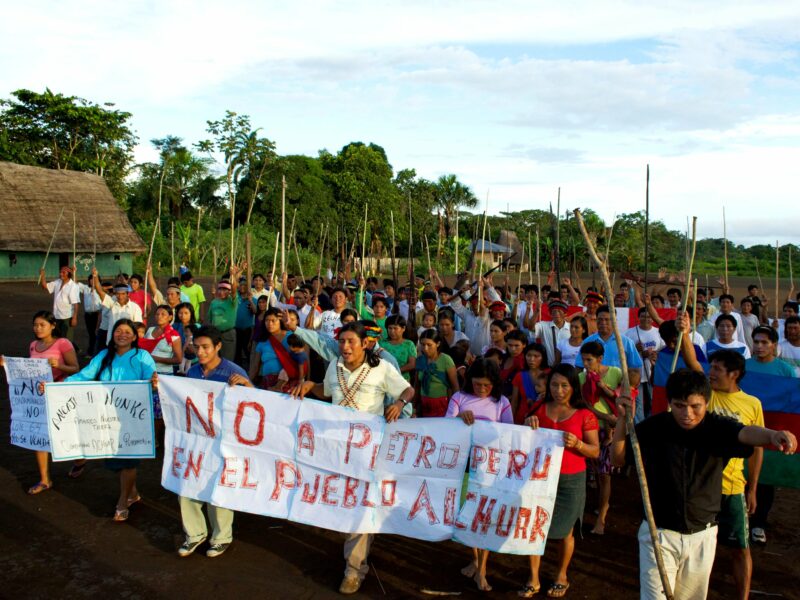
In the past, Shell worked here and almost all of us died from the diseases...We know that if another company comes here, our rivers and land will be destroyed. What will we eat when the rivers are dead and the animals have run away?

To fuel its ambitious export project, Hunt Oil has acquired another oil concession, Block 56, located on the lands of Machiguenga communities adjacent to Block 88. The demands of indigenous organisations for a transparent, free and informed consultation process regarding Block 56 were ignored, with no major structural changes to the process by which Block 88 was opened up. Along with neighboring blocks 57 and 90, an area or rainforest totalling nearly four million acres, some 10 times larger than the original Camisea concession of Block 88, will now be opened up to the devastating effects of gas extraction and the cumulative impacts this will have on both the ecosystems and their indigenous inhabitants.

Machiguenga
© Amazon Watch.
Camisea has a diverse indigenous population.


<< previous page

next page >>

Press Releases

March 21st, 2010 – Essential Reforms Still Necessary for an Effective Capital Increase at the Inter-American Development Bank
July 1st, 2009 – Inter-American Development Bank Must Enact Reforms Before Replenishment
March 31st, 2009 – No IDB Replenishment without Reform, Says Coalition
more »
Updates

March 21st, 2009 – AIDESEP, COMARU, CITIZEN ACTION FOR CAMISEA AND OTHERS EXPRESS OUR OBJECTION TO THE ORGANIZATION OF THE 7TH CAMISEA CONSULTATION MEETING, ORGANIZED BY THE INTERAMERICAN DEVELOPMENT BANK - IDB
August 19th, 2008 – Defensoria del Pueblo de Peru Pronunciamiento
August 14th, 2008 – AIDESEP Rechaza Acusaciones de Ministro de Energía y Minas Y desmintió a la PCM que informó erróneamente de nuevo, diciendo que las acciones de las comunidades fueron suspendidas.
more »
News Clips

April 1st, 2009 – Los representantes de la sociedad civil se van de Medellín "frustrados"
August 11th, 2008 – Indígenas amazónicos bloquean la ruta a Camisea Dirigente advierte que tomarán yacimientos desde donde se abastece planta de gas natural.
February 11th, 2008 – Se Incrementaría Fondo de Defensa con Regalías del Lote 57 de Camisea La Célula Parlamentaria de Unidad Nacional Planteó Destinar el 50% de Estas Regalías para Realizar Este Aumento
more »
Reports

March 28th, 2009 – IDB WATCH (IN SPANISH)
September 19th, 2007 – Holding the IDB and IFC to account on Camisea II
June 20th, 2006 – Informe Final de la Comisión Investigadora Encargada de la Investigación del Transporte de Gas del Proyecto Camisea
more »
Videos

Escuela Senen Soi

Format: Flash
YouTube

Format: Quicktime
Broadband

Length: 8:35
Released: October 29, 2008

dots
The Camisea Dilemma

Format: Quicktime
English:
Espanol: Dial-up | Broadband

Length: 12 minutes
Released: March 29, 2006

dots
Camisea Pipeline Scars Primary Rainforest

Format: Quicktime
English: Dial-up | Broadband
Espanol: Dial-up | Broadband

Length: 6 minutes
Released: July 2004

Photos


View photo slideshow
for campaign


Home : In the Amazon : Peru : Camisea Natural Gas Project
Join our email list site search:
Donate now


U.S. Federal Employees: Donate to Amazon Watch through the Combined Federal Campaign! CFC # 11616  

Home  |  Newsroom  |  In the Amazon  |  Capacity building  |  Take action  |  About us

© 2000-2010 Amazon Watch. All rights reserved.     Privacy Policy